What are octave bands, and how are they useful in managing noise? We take a closer look.
Octave bands can be an important and very useful tool for managing noise impacts during construction and operation. By providing a frequency breakdown they allow a better understanding of the noise profile and its likely impacts.
What are octave bands?
Octave bands are a way of breaking down the frequency spectrum of sound into smaller segments in order to gain a better understanding of the noise and its impacts. They allow a more detailed analysis of the sound energy and where it is concentrated.
Octave bands group frequencies in a way where the centre frequency has band limits roughly a factor of two apart – for example, the 125Hz octave band spans approximately 89.1Hz to 177.8Hz, per ISO226. For example, if the lower frequency is 125 Hz, the upper frequency of the octave band would be 125 x 2 = 250 Hz. So the octave band would range from 125-250 Hz.
Why are octave bands important?
The frequency of a noise is an important determinant of its impact on people, structures and the environment.
Low frequency noise, for example, travels further than high frequency noise, and so the area of potential impact is greater. Low frequency noise is also often felt as vibration, and can cause health disturbances – for example, to sleep or heart rate. While peak sensitivity often falls between 2-5kHz, the ISO226:2003 equal-loudness contours show humans perceive a broad range – from around 250Hz to 5kHz – with relatively high sensitivity, especially at typical construction noise levels.
So if we know the frequency of a noise, we can mitigate its impact more effectively and efficiently.
How can octave bands be useful during noise monitoring?
Octave bands have a number of uses when monitoring noise and mitigating its impact in construction and operational environments. They are useful on construction sites, as well as any operation facilities where there is significant noise, such as ports, quarries, mines, music and entertainment venues, server facilities, night clubs and more.
Octave bands can provide:
1. A more detailed analysis and understanding of noise
Different types of activities generate noise in different frequency ranges. By breaking this noise down into octave bands, it is possible to identify the type of noise and its likely source, and gain a better understanding of how it can be mitigated.
We generally know the frequency range of common noise sources. For example, some causes of noise and their frequencies include:
- Low frequencies (<250 Hz): Heavy machinery, piling, ship engines, bass music
- Mid frequencies (250–2,000 Hz): Excavators, generators
- High frequencies (>2,000 Hz): Cutting, grinding, alarms
These noise sources have different impacts depending on their frequency. For example:
- Pile drivers: Emit significant low-frequency noise (around 63–125 Hz), which can travel long distances and penetrate building structures.
- Excavators: Produce mid-frequency noise (approximately 250–500 Hz), contributing to the overall ambient noise level on site.
- Cutting tools: Generate high-frequency noise (above 1,000 Hz), which is more directional and can be more easily mitigated with barriers.
Understanding these frequency profiles is crucial for implementing effective noise control measures tailored to the specific equipment in use. Octave bands help you identify the noise source and whether its related to construction or operational work – for example, whether it’s a compressor, truck, ship, music, or something else entirely that’s causing the issue.
2. Octave bands support compliance with regulations
Some noise regulations or planning conditions specify limits for different octave bands – especially when protecting sensitive receptors like schools or wildlife. Having access to an octave band breakdown of monitored noise makes it much easier to comply with regulations and avoid penalties.
In some places, for example, regulators use frequencies as an indicator of how ‘annoying’ a noise is, as evidence suggests that low frequencies are more disturbing for people than higher frequency sounds at the same noise level. Penalties are therefore set and applied based on the frequency content of noise, to match the corresponding level of annoyance.
As an example, the Noise Policy for Industry (which governs NSW operational noise) applies penalties for noises that have a lot of low frequency content, and their method for calculating these penalties takes into account the noise frequency. This makes it crucial to understand the frequency content of your noise sources in order to meet the criteria and avoid penalties.
3. Octave bands provide data for noise mitigation
Once you know the dominant frequency of a problem sound, you can choose the most effective mitigation. The frequency also determines how far the noise will travel, so mitigation can be more efficient, as high-frequency noises, for example, will not travel as far as low-frequency sounds.
SiteHive Enviro puts octave bands in your control
SiteHive Enviro makes it easy to understand and use octave bands when monitoring noise.
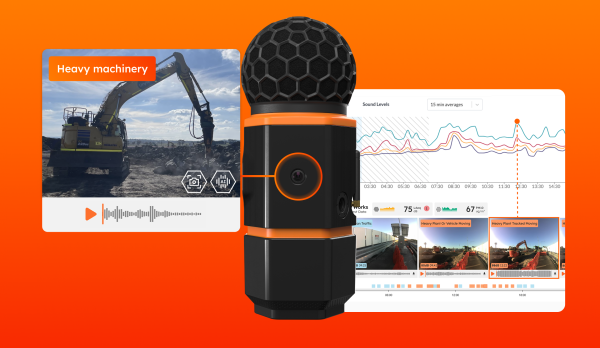
The interactive Dashboard provides a graphical representation of octave bands in real time, so you can immediately see any noise broken down into its octave band frequency.
You can also view the octave bands for specific periods of time – for example when certain machinery is operating – to easily identify the dominant frequencies for that particular period. You have the information at your fingertips to understand specific sounds and frequencies, and their impact.

So if you’re dealing with the noise during construction or operational environments – ports, quarries, mines, night clubs, server facilities and more – see how SireHive Enviro can make it easier.
Like more info?
- Learn more about our noise monitoring devices and software here.
- Have questions? Chat with us live or get in touch anytime.
What you’ll find out:
- What are octave bands
- How they can be useful for noise monitoring and mitigation
- Octave bands in SiteHive Enviro – how they make it easier
Discover our noise monitoring offer
Learn more about our noise monitoring devices and software.