Weather doesn’t ask permission before it shuts down a pour, stops a crane, or turns a compliant site into a non-compliant one overnight. For an industry that runs on tight programmes and tighter margins, it remains one of the few risks that can’t be negotiated away. All we can do is try and manage it.
Here we look at the impact of weather on construction projects, and how best practice processes and modern tools can actually make projects much more weather-proof!
The cost of weather delays in construction
Weather is one of the largest and most consistent sources of delay and cost over-run in construction. An estimated 45% of construction projects worldwide experience weather-related delays, and a single widespread weather event can push project duration and cost up by 20% or more.
The numbers are larger and more consistent than most site teams assume:
- Roughly 21% of all construction delays are attributed directly to weather. That’s a significant proportion and, therefore, a significant impact.
- The Construction Industry Institute puts the average cost increase from weather delays at 5–15% of project value. So a $1 million project is likely to have say $100k in weather-related costs; on an infrastructure project of $500 million, that’s $50 million of weather costs. The numbers soon add up.
- A 2025 peer-reviewed survey of 242 construction industry professionals published in Buildings identified that weather-related delays lengthen project duration by around 25.7% and increase costs by around 23.8% on average.
- Storm-related disruption costs alone are estimated at US$12 billion a year globally in delays, material damage and equipment loss.
These figures also only capture delays attributed to weather. They don’t capture the secondary costs of reduced productivity on marginal days, disputed time extensions, or the standing cost of plant and labour while everyone waits to see what a storm does next.
The figures also show how managing weather effectively during a construction project can deliver significant benefits in terms of lowering costs and saving time – the potential savings are huge. You can’t stop the rain, but you can manage operations around it to maintain site productivity.
Why weather keeps costing more than it should
Construction teams make critical operational decisions every day, yet many are relying on weather information that doesn’t accurately reflect conditions on site. They often also have to deal with multiple disparate systems, and weather monitoring becomes guess work.
A site manager checks a weather phone app before the morning briefing, makes a call, and hopes it holds; someone relies on analogue devices such as tipping bucket rain gauges or spinning anemometers.
The gaps in these approach can show up in a few ways:
- Wind risk on cranes and formwork. Lifting limits are exceeded before anyone on the ground notices the gusts have picked up.
- Rain and site access. Heavy rainfall turns access roads to mud, delays concrete pours, and triggers erosion and sediment control obligations that weren’t front of mind an hour earlier.
- Heat and worker safety. Heat stress builds gradually, and by the time it’s obvious, it’s already affecting people.
- Compliance exposure. Many approvals carry weather-triggered conditions. If there’s no record of what conditions actually were on site, that’s a gap an auditor or a neighbour will find.
None of these are new problems. What’s changed is that they no longer have to be managed by guesswork.
What good weather management looks like
Weather-sensitive activities are concentrated, not spread evenly. Earthworks and excavation, concrete placement, crane operations, and external finishing (cladding, roofing, painting) carry most of the exposure. This means a small number of activities usually drive most of the schedule risk.
Construction sites that handle weather well share a few habits, regardless of what tools they use. These are things like:
- Monitoring at the site, not the suburb. A BOM forecast from kms away can miss the microclimate effects a site actually experiences. Things like wind funnelling between structures, or a valley that holds rain longer than the area around it.
- Thresholds set in advance. Wind, rain, and temperature limits are agreed and set ahead of project activities. And reviewed and updated if necessary over time.
- Alerts that reach the right person automatically. The person who needs to stop a pour should be the first to know conditions have changed.
- A record that holds up later. When a regulator, insurer, or client asks what conditions were on site at a given time, the answer should be recorded and available.
Where SiteHive fits in weather management
SiteHive Weather is designed to automate these workflows and use cases, and deliver the relevant information and insights to the people who need them.
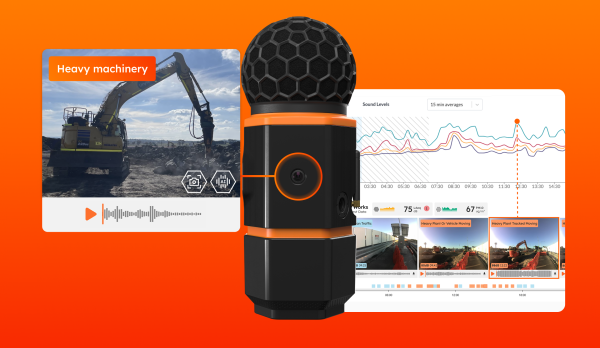
A SiteHive Hexanode Weather device on site measures actual local conditions where the work is happening, including wind speed and direction, rainfall, temperature, and humidity.
Rules in SiteHive Enviro and Enviro Pro turn agreed thresholds into automatic notifications, so a wind limit approaching a crane’s lifting capacity reaches the right person by SMS or email before it becomes a safety incident.
And because every reading is timestamped and stored, the project has a defensible, site-local record ready for the moment a regulator or client asks for one.
The bigger picture: weather impacts are likely to get worse
As climate variability increases, weather risk on construction sites isn’t going away. If anything, the swings are getting sharper and less predictable.
The sites that adapt won’t be the ones that get lucky with the forecast. They’ll be the ones that already know, in real time, exactly what’s happening at their site, and have built their responses into how they work.
Find out more
To learn more about how SiteHive helps teams manage weather impacts during construction and operations, contact us or explore sitehive.com
The Construction Industry Challenges Blog Series
This article, Managing Weather Impacts on Construction Sites: Costs, Causes and Fixes, is the second blog in our series examining the new challenges of managing environmental management in construction.
We’ll cover the changing landscape and shifts in the construction industry, and specifically what it all means for environmental management; how impact needs to be managed on today’s projects; and what SiteHive is building to help environmental teams, consultants, contractors and others respond to the new industry challenges.
Over the coming weeks we’ll be publishing articles on a range of topics including:
- From Megaprojects to Megabuildings: The New Shape of Construction
- Managing Weather Impacts on Construction Sites: Costs, Causes and Fixes
- Protecting Sensitive Equipment in Dense Urban Construction
- Data centre builds – how to build faster and be a good neighbour
FAQs
What you’ll find out:
- The costs of weather delays in construction
- Why weather is affecting site productivity
- The best processes for managing weather
- How SiteHive Weather monitoring works
Discover SiteHive
See how you can use SiteHive devices and software to easily and accurately monitor and manage weather during construction and operations.