Australian construction is going through the biggest shift in a generation. Infrastructure is plateauing, and what’s replacing it looks nothing like what came before. Here we look at one of the major shifts: from megaprojects to megabuildings.
For the past 30 years, Australian and New Zealand construction has been defined by an infrastructure supercycle. The NBN rollout gave way to a mining boom. The mining boom gave way to a wave of transport megaprojects, such as Sydney Metro, the M80 motorway in Melbourne, and Aucklands City Rail Link. This development has reshaped our cities and dominated headlines, budgets and construction workforces for a generation.
That supercycle is now plateauing. And it’s being replaced by something that we haven’t really seen before: a new tier of industrial-scale buildings that includes data centres, hospitals, schools, and advanced manufacturing facilities. These buildings increasingly look and behave like infrastructure projects, even though they sit on a single site, with a single client.
Construction is becoming a buildings industry again. But a very specific kind of building.
The shift from infrastructure to buildings
We’re moving into a new world of data centres, hospitals, schools and dense urban development. These bring a different, often more complex, set of environmental impact-management challenges.
Data centres are key – the numbers make the scale of this shift hard to ignore
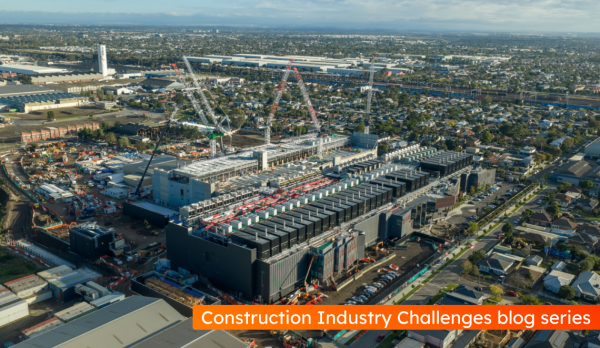
A single data centre now sits at infrastructure-mega-project scale. In NSW alone, the proposed Mamre Road Data Centre Campus at Kemps Creek is a $5 billion, six-building, 400,000 sqm development. And it’s not the only one.
For comparison, Sydney Metro West – one of the country’s flagship transport projects – is now estimated at $27–29 billion. That means two data centre projects in Western Sydney alone represent roughly a quarter of the cost of a major metro rail line.
The speed of the development is also different. Metro West will take the better part of a decade to deliver, while data centre campuses are typically built in around three years. And this speed differential is only likely to get bigger as teams gain more experience and the competition for data centre work grows.
Health is emerging as a institutional anchor of the buildings pipeline.
Infrastructure Australia’s 2025 Infrastructure Market Capacity Report puts buildings investment at $77 billion, which is 32% of the national Major Public Infrastructure Pipeline and up $6 billion on the previous year. One of the two categories driving this figure is health projects at $22 billion. Health investment now rivals the road programs of most states.
The other key category is social and affordable housing.
The report puts social and affordable housing investment at $28 billion, up sharply from $17 billion the previous year. Housing builds are now both a strong political and practical imperative.
Infrastructure Australia also expects overall public infrastructure investment to peak in 2027 as buildings continue to take a larger share of the pipeline.
Put together, these numbers tell a clear story: buildings like data centres, hospitals, advanced manufacturing plants and housing sites are being delivered at a speed, scale and capital intensity that used to be reserved for nation-shaping transport infrastructure.
Why this shift matters for impact management
Transport megaprojects are disruptive, but they’re also well understood. Decades of tunnelling, road-building and rail delivery in Australia and New Zealand have produced mature frameworks for environmental management, community consultation and compliance reporting. Everyone – from contractors to regulators to residents – has some sense of what a multi-year transport project looks like.
Data centres, hospitals and dense urban builds are a different proposition.
- They’re compressed. A $5 billion data centre campus can be built in roughly a third of the time of an equivalent-value transport project, meaning noise, dust and traffic impacts are concentrated into a much shorter, more intense delivery window.
- They sit closer to communities. Health facilities and schools are, by definition, embedded in the neighbourhoods they serve. Data centres are increasingly being built on the edges of suburban growth corridors, next to homes rather than easements.
- Negative community sentiment is strong. Data centres in particular are experiencing significant community push back and negative press. In order for a data centre to be first approved, and then built, contractors must minimise community impact and build trust. Being a “good neighbour” is important for social licence and productivity.
- They carry different technical risk profiles. Backup power, cooling systems, high-voltage infrastructure and large-scale battery storage introduce environmental and safety considerations that don’t map neatly onto traditional civil construction playbooks.
- They’re backed by different capital. Hyperscaler and sovereign capital investment decisions move fast, and project timelines are often driven by global or national demands rather than local planning cycles. This puts pressure on delivery teams to manage impacts in real time, rather than retrospectively.
The result is a class of projects that behave like infrastructure in scale and capital intensity, but demand the agility, transparency and community engagement of a single-site building project.
In this environment, modern tools like SiteHive are even more important in helping projects optimise the construction schedule, stay within limits at all times, and streamline the reporting and complaints processes. They can make a big difference to both project productivity and outcomes.
What is SiteHive doing to support this shift
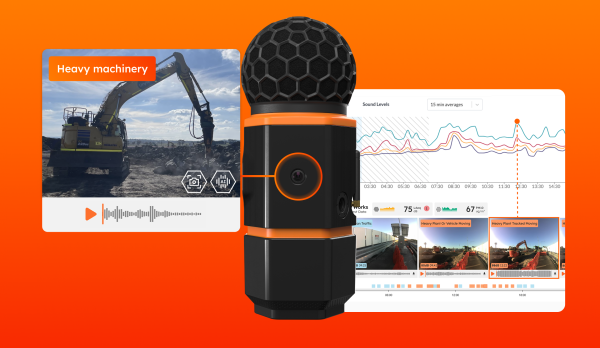
SiteHive is building new environmental management tools, measurements and workflows to help teams manage these challenges in real time. As the industry’s project mix shifts, our platform is evolving alongside to support it.
We’re bringing real-time noise, dust, vibration, water and weather monitoring that’s proven itself on major infrastructure projects, and adding new capabilities that are suited to the compressed, high-scrutiny delivery environment of data centres, hospitals and dense urban builds.
For example, SiteHive has been working on data centre projects for 5+ years across Australia and New Zealand, including projects in Sydney and Auckland with Microsoft. We’re using that experience to deliver insights that enable contractors to make faster, more confident decisions, and help deal with the community scrutiny and impact that are a key part of the data centre challenge. The tools are designed to enable contractors to build faster, while also being a good neighbour.
For hospitals and dense urban environments, SiteHive’s extensive practical experience has resulted in new capabilities designed specifically for those projects. For example, works can happen metres from operating theatres, IVF labs and imaging suites, where equipment is much more sensitive to vibration than when monitoring for structural damage. SiteHive’s Vibration Criterion (VC) Curves cater for this, allowing VC curve monitoring in real time on the same device that also measures structural vibration (PPV), human comfort vibration (VDV), and ground-borne noise (LAeq). This capability is at work inside and outside live hospital redevelopments right now.
Find out more
To learn more about how SiteHive helps teams manage environmental impact on data centre, health and complex urban development projects, contact us or explore our sitehive.com
The Construction Industry Challenges Blog Series
This article, From Megaprojects to Megabuildings: The New Shape of Construction, is the first blog in our series examining the new challenges of managing environmental management in construction.
We’ll cover the changing landscape and shifts in the construction industry, and specifically what it all means for environmental management; how impact needs to be managed on today’s projects; and what SiteHive is building to help environmental teams, consultants, contractors and others respond to the new industry challenges.
Over the coming weeks we’ll be publishing articles on a range of topics including:
- From Megaprojects to Megabuildings: The New Shape of Construction
- Managing Weather Impacts on Construction Sites: Costs, Causes and Fixes
- Protecting Sensitive Equipment in Dense Urban Construction
- Data centre builds – how to build faster and be a good neighbour
References
- Infrastructure Australia, 2025 Infrastructure Market Capacity Report (13 November 2025) — buildings investment, Major Public Infrastructure Pipeline share, health and housing figures, workforce and peak-investment data: infrastructureaustralia.gov.au/reports/2025-infrastructure-market-capacity-report
- DataCenterDynamics, “Plans filed for 1GW data center campus in Sydney, Australia” — Mamre Road Data Centre Campus cost, building count and floor area: datacenterdynamics.com/en/news/plans-filed-for-1gw-data-center-campus-in-sydney-australia
- DataCenterMap, “Mamre Road Data Centre Campus in Sydney | ISPT” — corroborating detail on the Mamre Road campus (site area, substations, hyperscale positioning): datacentermap.com/australia/sydney/mamre-road-data-centre-campus
- ABC News, “Cost of Sydney’s new metro lines blows out by $6 billion” (5 December 2025) — Sydney Metro West revised cost estimate of $27–29 billion: abc.net.au/news/2025-12-05/sydney-metro-west-cost-blowout-to-6-billion/106107980
- NSW Government, “Westmead metro station reaches major construction milestone with updated project costs released” — confirms the $27–29 billion Metro West figure from the same December 2025 budget baseline review: nsw.gov.au/ministerial-releases/westmead-metro-station-reaches-major-construction-milestone-updated-project-costs-releasedSiteHive Hexanode monitoring devices
FAQs
What you’ll find out:
- How the construction landscape is changing
- What’s driving the change, including the financial numbers
- What this means for managing environmental impact
- Tools to help manage in the new environment
Discover SiteHive
See how you can use SiteHive devices and software to easily and accurately monitor and manage environmental impacts during construction and operations.