Knowing that a vibration exceedance occurred is only part of the story. Understanding what caused it is what enables environmental teams to make faster, more informed decisions.
The SiteHive Waveform Classifier is a new capability that automatically classifies vibration events as construction or non-construction, giving project teams immediate context around every vibration exceedance. Rather than simply recording vibration exceedances, SiteHive helps users understand them.
Developed in collaboration with Renzo Tonin & Associates and researchers from the University of Technology Sydney, the Waveform Classifier uses AI to reduce the time spent manually reviewing vibration waveforms, while providing confidence in compliance reporting and stakeholder communication.
Turning vibration exceedances into actionable insights
Construction vibration monitoring typically relies on measuring Peak Particle Velocity (PPV) to identify when vibration limits have been exceeded. While monitoring systems can accurately detect exceedances, interpreting the cause has traditionally remained a manual task.
Normally, every vibration exceedance would require an expert (such as an environmental manager or acoustic consultant) to inspect the recorded waveform and identify its source. To decide, for example, if it was likely generated by construction activities, external sources such as traffic, or simply by someone interacting with the monitoring device.
On busy infrastructure projects, this process is repetitive, time-consuming and often subjective.
The SiteHive Waveform Classifier changes that.
It captures every waveform during a vibration exceedance and uses smart AI tools to automatically and instantaneously analyse and classify them. So Enviros and Consultants have an initial recommendation of the source of a vibration exceedance, which they can use to triage or investigate further.
The result is a faster, more consistent workflow that helps teams understand what happened without having to manually assess every waveform.
Automatic AI classification built into SiteHive Enviro Pro
The Waveform Classifier is fully integrated into SiteHive Enviro Pro and automatically analyses every recorded vibration waveform associated with a vibration exceedance.
Each event is classified as either:
- Construction – indicating the vibration is likely to have been generated by construction activities.
- Non-construction – identifying events more likely to have originated from external sources or human interaction with the monitoring equipment.
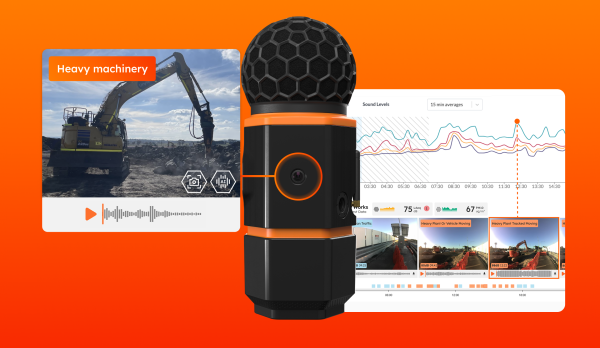
The classification is colour coded – orange for construction; blue for everything else – and displayed alongside the recorded waveform. This makes it easy to quickly review events and prioritise further investigation where required. (For those familiar with it, the Waveform Classifier uses the same intuitive visual experience as SiteHive’s Audio Classifier.)
Instead of starting every investigation with a blank waveform, environmental managers and consultants immediately have an AI-generated assessment to support their review.
Reduce manual investigation and improve compliance workflows
The Waveform Classifier provides an assessment of waveforms to support environmental professionals. Users can still review every waveform while benefiting from faster triage and more consistent interpretation.
It helps project teams:
- Review vibration exceedances more efficiently
- Distinguish genuine construction vibration from unrelated activity
- Reduce the time spent manually interpreting waveforms
- Improve consistency across project teams
- Build confidence when communicating results with regulators, clients and community stakeholders
- Focus investigations on events that require further assessment.
For projects generating hundreds or even thousands of vibration events, these efficiency gains quickly add up to significant time savings.

Built for vibration monitoring in construction
The Waveform Classifier has been designed for construction projects where vibration monitoring plays a critical role in environmental compliance, including:
- Major infrastructure projects
- Rail and metro construction
- Tunnel and underground works
- Piling and foundation construction
- Projects with vibration-sensitive receivers
- Urban developments operating near occupied buildings or critical infrastructure
Environmental managers, site engineers and acoustic consultants all benefit from faster access to meaningful vibration data and greater confidence in interpreting exceedances.
Developed with industry-leading experts
To ensure the classifier performs reliably in real-world construction environments, SiteHive developed the Waveform Classifier in collaboration with Renzo Tonin & Associates and researchers from the University of Technology Sydney.
The result is an AI model trained specifically to distinguish construction-related vibration from non-construction events, helping reduce uncertainty while supporting more efficient environmental monitoring workflows.
Smarter AI for environmental monitoring
The Waveform Classifier builds on the success of SiteHive’s AI-powered Audio Classifier and represents another step forward for intelligent environmental monitoring.
Rather than simply recording vibration exceedances, SiteHive helps users understand them. By transforming raw vibration waveforms into classified, actionable events, environmental teams can spend less time reviewing data, respond more quickly to incidents and make more confident decisions throughout the life of a project.
Find out more
The Waveform Classifier is provided as part of SiteHive Enviro Pro. For details on how it works and how to use it, check out this webinar and/or the SiteHive Help Centre, or chat to our Support team online (real people, not bots!).
Or if you’re not currently using SiteHive Enviro Pro, just contact us for more info.
FAQ
What you’ll find out:
- What is the SiteHive Waveform Classifier
- How you can use it to identify construction vs non-construction vibration impacts
- Which projects is it useful for
Like more info?
Discover how SiteHive Hexanode devices and SiteHive Enviro software make real-time environmental monitoring easy.