SiteHive presented an important research paper on using vibration to monitor ground-borne noise at Acoustics 2025. Here we summarise the research, and explain why it transforms the monitoring and management of ground-borne noise.
SiteHive Hexanode Vibration provides a breakthrough in ground-borne noise monitoring: it’s a remote, non-intrusive device that estimates ground-borne noise accurately and in real time. Validated by direct measurements and acoustic consultants, it makes ground-borne noise monitoring easier, scalable and lower cost. And, importantly, allows ground-borne noise monitoring without disturbing residents.
Authors
Ben Cooper-Woolley (1), Michael Manraj Darroch (1), Stuart Anstee (2) and Dr Ben Halkon (3)
(1) SiteHive, Sydney, Australia, (2) John Holland CPB Contractors Ghella Joint Venture, Sydney, Australia, (3) School of Mechanical and Mechatronic Engineering, University of Technology Sydney, Sydney, Australia
Understanding ground-borne noise: why it matters
It’s important to manage ground-borne noise as it is a particularly impactful noise source. That’s because:
- It contains low-frequency energy that can be “felt” as much as it is heard
- Tunnelling and other works that generate ground-borne noise are often carried out at night, and so it can be particularly disturbing for residents
The allowable limits are therefore lower than typical indoor noise levels. For example, the NSW guidelines set nighttime limits of:
- 40 dBA LAeq (evening)
- 35 dBA LAeq (night)
These low limits are frequently exceeded during tunnelling, rock hammering, and roadheader operation, making accurate monitoring essential for community management.
Why ground-borne noise is so hard to monitor
Ground-borne noise is one of the most challenging environmental impacts to measure on major infrastructure projects. Ground-borne noise travels through the ground and structures, creating low-frequency “rumbling” sounds that can disturb residents, especially at night.
Traditionally, monitoring ground-borne noise requires setting up a microphone inside someone’s home. This is intrusive, raises privacy concerns, and doesn’t clearly separate the sound produced by construction from everyday household noise. Everything from footsteps to appliances can contaminate the data.
With infrastructure, tunnelling and underground construction projects happening across Australia and New Zealand, teams need a more reliable, practical, easier and cost-effective way to measure ground-borne noise and manage its impacts.
The problems with existing monitoring methods for ground-borne noise
1. Direct noise monitoring inside homes
The NSW Interim Construction Noise Guideline requires internal measurements to be taken at the centre of the most affected habitable room. But direct measurement has a number of limitations as it:
- Is intrusive and often unacceptable to residents
- Provides mixed airborne/ground-borne data
- Requires specialised acoustic analysis
- Cannot be deployed long-term
- Is expensive and time-consuming to repeat.
Even when performed carefully, direct measurements are often overwhelmed by everyday household noise, masking the true ground-borne noise levels caused by construction.
2. Indirect vibration-based estimation
Indirect methods, which involve estimating ground-borne noise from vibration, have been validated by researchers for decades (see References below). But, until recently, they required:
- Bespoke technical set-ups for automated remote monitoring
- Custom scripts for processing
- Experts to interpret the data.
This complexity meant indirect ground-borne noise monitoring was rarely used for long-term or real-time applications.
A new approach: remote, real-time, unintrusive ground-borne noise monitoring
SiteHive set out to solve this challenge: develop an unobtrusive, easier way to monitor ground-borne noise.
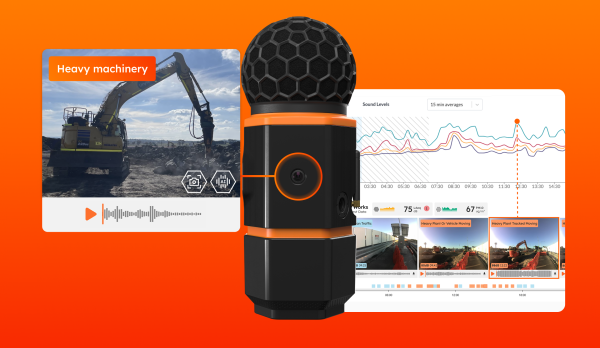
The result is the innovative SiteHive Hexanode Vibration device, which delivers real-time data directly into SiteHive’s cloud-based system, SiteHive Enviro Pro, and includes a purpose-built ground-borne noise processing chain.
How SiteHive transformed ground-borne noise monitoring
Applying the Kurzweil method in real time
The SiteHive system applies a modernised version of the Kurzweil formula (Kurzweil, 1979; Association of Noise Consultants, 2012), which is a commonly-used and relatively simple method of estimating ground-borne noise.
The formula states that the unweighted sound level in decibels is approximately equal to the root-mean-square (RMS) vibration level of the floor, minus a constant scaling factor k (27dB for a typical room). A-weighting the results in ⅓ octave bands between 20-250Hz, and then summing them, gives an approximate LAeq for the period in question (Karantonis, Weber and Puckeridge, 2019).
SiteHive was able to significantly improve the ground-borne measurement process using the SiteHive Hexanode Vibration device and some innovative development. The new process involves:
- Measuring raw accelerations via 3 tri-axial, mems-based accelerometers.
- Using a separate digital signal processing chain that was developed by SiteHive and built into the device firmware. This processing chain A-weights the raw signal, integrates it into the velocity, and then calculates 1-minute, RMS velocity results.
- Passing the results through a filter and band-limiting them to 250Hz to isolate vibration signals that are likely to cause ground-borne noise.
- The process above produces a 1-minute aggregated, A-weighted RMS velocity value.
- The data is immediately available in the SiteHive Enviro Pro platform, which adds a scaling factor that is specific to the location/room and converts it into an LAeq estimation of the ground-borne noise.
- The SiteHive Enviro Pro system presents the results automatically and graphically, making it easy to see the ground-borne noise measurements and if there are issues or exceedences.
Developing a custom digital signal processing chain
The processing chain is a key part of the process, and it is built directly into SiteHive Hexanode Vibration devices. It provides:
- Conversion of real-time acceleration to RMS velocity integration
- A-weighting for vibration
- DC rejection and low-frequency noise suppression using octave band limits
- 1-minute RMS velocity calculations
- Configurable ground-borne noise scaling factors per monitoring location
Field deployment: Sydney Metro West – Eastern Tunnelling Package
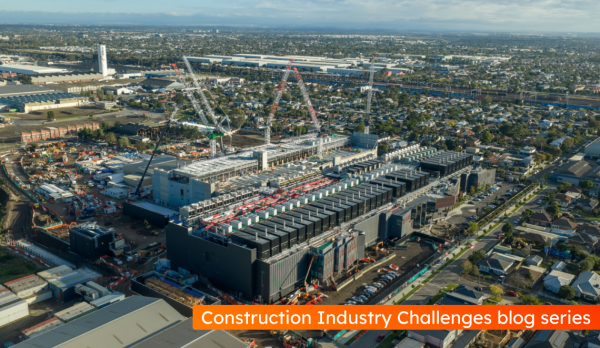
The solution was tested and validated on the Sydney Metro West – Eastern Tunnelling Package (ETP), one of Australia’s largest infrastructure projects.
The ETP project includes tunnelling under Sydney Harbour, excavation of cavern stations, and extensive rock hammering and roadheader work. These are the types of activities that generate significant ground-borne noise.
SiteHive Vibration devices were installed across multiple sensitive residential locations. The devices run continuously on low power and are small and automated, so they can be deployed quickly and discreetly at sensitive receivers.
At each site the following activities were carried out:
- Direct internal measurements were performed to set a calibration (scaling) factor
- Devices were then left in place for long-term remote monitoring
- Data was validated against both direct and indirect consultant measurements throughout delivery
This provided one of the most comprehensive comparative datasets for indirect ground-borne noise monitoring on an Australian construction project.
Results: Accuracy within 1 dB of direct measurements
The results, taken across multiple locations and activities, were very clear:
- The SiteHive solution estimates matched direct measurements within ~1 dB.
- Even during high-energy activities (for example, 50-t rock hammering, roadheader work), the correlation is excellent.
- The measurements are unaffected by room/location-based noise.
The indirect results were fully validated by direct methods and independent consultants, who reported consistency across multiple locations.
Why this matters for construction teams
There are several important advantages to this system:
Non-intrusive monitoring
No need to enter homes or place microphones inside rooms. This delivers benefits for construction teams and residents.
Real-time insights
Teams see ground-borne noise levels live and can adjust work immediately.
Scalable, lower-cost ground-borne noise monitoring
Low-cost devices and remote monitoring mean many properties can be monitored simultaneously.
Clearly separates ground-borne and room-based noise
SiteHive’s method is not affected by people talking, footsteps, general household noise, etc; it isolates construction activity cleanly.
Provides consistency across long projects
Removes the variability and subjectivity of attended surveys.
Reduced need for expert interpretation
Clear dashboards in SiteHive Enviro automatically visualise ground-borne noise impacts, replacing complex raw data files.
Conclusion
The development of the SiteHive Hexanode Vibration’s ground-borne noise capability represents a major step forward for environmental monitoring on infrastructure and construction projects.
For the first time, construction teams can accurately estimate ground-borne noise in real time, continuously and at scale, without disturbing residents.
With accuracy validated against both direct acoustic measurements and independent consultants, this technology finally makes ground-borne noise monitoring:
- Scalable – deploy across multiple receiver locations
- Non-intrusive – residents remain undisturbed
- Real-time – data delivered instantly to SiteHive’s cloud platform
- Cost-effective – minimal labour, maximum insight
This enables more proactive community engagement, better impact management, and a more predictable pathway to delivering tunnelling, excavation and other major works in dense urban environments.
Read or download the full Research Paper
References
- Alten, K., Friedl H., & Flesch R. 2010 – Calculating Ground-Borne Noise From Ground-Borne Vibration – A Comparison of Different Approaches.
- Anderson, D. & Sburlati D. 2016. Monitoring ground-borne and structure-borne noise for management of construction impacts.
- Association of Noise Consultants. 2012. ANC Guidelines – Measurement and Assessment of Ground-borne Noise & Vibration
- Darroch, M-M., Cooper-Woolley, B., Halkon, B. 2023. “Design and development of SiteHive MEMS based system for real-time vibration monitoring”. The Journal of the Acoustical Society of America 154(4): A303-A303.
- Davis, D. 2010. A Review of Prediction Methods for Ground-Borne Noise due to Construction Activities.
- Department of Environment & Climate Change. 2009. Interim Construction Noise Guideline.
- Federal Transit Administration. 2018. Transit Noise and Vibration Impact Assessment Manual.
- Halkon, B., Darroch, M-M., Cooper-Woolley, B., Zhao, S, Miller, A, Hanson, D, Marrinan, M, Hendy, A, Parnell, J, and Mifsud, S. 2024. Advancing AI-based Acoustic Classifiers for (Rail) Construction Noise – A Pilot Project.
- Karantonis,P., Weber, C., and Puckeridge, H. 2019. Ground-borne Noise & Vibration Propagation Measurements and Prediction Validations from a Railway Tunnel Project.
- Kurzweil, L.G. 1979. “Ground-borne noise and vibration from underground rail systems.” Journal of Sound and Vibration 66 (3): 363-370.
- Melbourne Metro Rail Project. 2016. Appendix B. Construction: Vibration and Ground-borne Noise. Revision C1.
- Zapfe, J. 2005. TCRP D-12 [Final]. Ground-Borne Noise and Vibration in Buildings Caused by Rail Transit.
What you’ll find out:
- How SiteHive Vibration devices can be used to accurately measure ground-borne noise
- How ground-borne noise is estimated
- The results of the research conducted
- The benefits of the new process
Discover SiteHive Vibration
See how you can use SiteHive devices and software to easily and accurately monitor and manage vibration impacts, including ground-borne noise.