Explore how Australia’s mining and construction industries manage structural vibration with strict regulations. SiteHive breaks it down for you!
In Australia, industries like mining and construction follow strict rules for managing noise and vibration. In addition to official government guidelines, Australia uses several other international standards to ensure workers and local communities aren’t adversely impacted by vibration.
Key guides and standards in Australia include:
- The AS 2436 Guide to Noise and Vibration Control on Construction, Demolition, and Maintenance Sites.
- The DIN 4150-3:2016-12 A German standard for evaluating vibrations’ impact on structures.
- The BS 7385-2:1993: Evaluation and measurement for vibration in buildings Guide to damage levels from groundborne vibration
Australia’s vibration monitoring guide: The AS 2436
The Australian Guide to Noise and Vibration Control on Construction (AS 2436), gives comprehensive guidelines for managing these environmental impacts. It ensures compliance with the Environment Protection Act 1997 and the Environment Protection Regulations 2005.
- It covers the preparation of noise and vibration management plans, work method statements, and environmental impact studies.
- While vibrations can be noticeable, they often result in only minor, easily repairable cosmetic damage, such as small cracks in plaster.
- The guide encourages proactive steps, like making detailed plans that account for noise and vibration effects on nearby communities and infrastructure.
- Following these guidelines helps construction sites reduce negative impacts, making it safer and more comfortable for workers and residents.
The AS 2436 standard serves as a foundational document, providing clear instructions on best practices and compliance requirements, thereby supporting sustainable urban development.
The primary method of measuring structural impacts caused by vibration is to measure Peak Particle Velocities (PPV), in mm/s.
International vibration monitoring standards used in Australia
Australia integrates international standards into its regulatory framework to uphold uniform safety standards.
Two significant international standards are the DIN 4150-3 and BS 7385-2, which provide guidelines for assessing the impact of vibration on structures. For impacts on human comfort, the primary references are DIN 4150-3 and BS 6472-2.
These standards are known for their thorough way of measuring and evaluating vibration, with clear limits for what’s acceptable.
By adopting these international benchmarks, Australia ensures that its construction and demolition practices meet global best practices, providing a robust framework for managing environmental impacts.
The German standard DIN 4150 for structural monitoring
The DIN 4150 standard, established by the German Institute for Standardization, defines vibration velocity limits to assess structural integrity. The standard has more stringent tolerances than the equivalent British standard. The standard uses a frequency based assessment, with lower velocity thresholds at lower frequencies.
This standard is widely respected and used internationally, including in Australia, for its clear delineation of vibration velocity limits to prevent structural damage.
This approach helps engineers understand how buildings respond to vibration, making sure structures can handle the forces during construction or operation, and keeping them safe.
- According to the DIN 4150 Part 3, continuous vibrations up to 10 mm/s are generally safe for industrial buildings, while higher levels may lead to minor or significant structural issues.
- This standard requires evaluating the overall structural response to vibration, beyond just natural frequency calculations.
- This approach helps engineers understand how buildings respond to vibration, making sure structures can handle the forces during construction or operation, and keeping them safe.
The British standard BS 7385 for structural monitoring
The British Standard BS 7385 sets rules for assessing how vibration affects buildings and checks how much vibration is safe for people inside. It is generally more lenient than the DIN 4150. The standard also uses a frequency based assessment, with lower velocity thresholds at lower frequencies.
It is an essential reference in Australia for managing vibration effects in construction and demolition projects.
- This standard focuses on establishing safe limits to prevent damage, particularly for buildings of historical or architectural significance. It also considers the type and purpose of the building, recognizing that residential and commercial structures may have different tolerance levels.
- BS 7385 is only applicable to vibration transmitted through the ground, not to vibration caused by machinery set up inside a building. So, chimneys, bridges and underground structures (such as chambers, tunnels and pipelines) aren’t covered by this standard.
- By offering a detailed framework for assessing potential risks, BS 7385 provides a detailed way to assess risks, helping make sure construction doesn’t harm existing buildings.
How you can implement the Australian vibration control standards on your construction site
The best way to comply with vibration monitoring standards is to use dedicated devices that can monitor vibration levels across your construction site in real-time. This allows swift abatement measures when peak vibration levels exceed max limits.
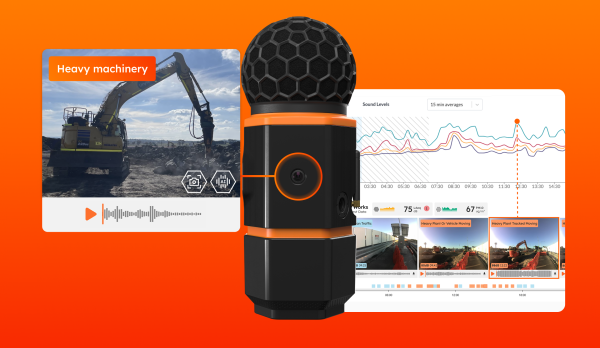
SiteHive Enviro Pro software and SiteHive Hexanode devices provide comprehensive solutions for monitoring and managing both structural and human comfort vibrations in real time.
Monitoring and analysis with SiteHive
SiteHive Enviro Pro software delivers real-time visibility into the sources of vibrations on your site. This system enables the rapid identification of vibration events, simplifying reporting and ensuring compliance with regulatory requirements.
SiteHive’s tools include several key functionalities to keep stakeholders informed:
- See Vibration Trends: The software calculates summary statistics for peak velocities and Vibration Dose Values (VDVs) instantly, providing a clear view of vibration patterns over time. It also assesses whole body vibration, crucial for workplace health and safety, by measuring exposure and mitigating risks associated with machinery use.
- Frequency Impact Analyses: SiteHive graphs and analyzes frequency-based impacts, identifying potential project risks associated with specific vibration frequencies.
- Ground-Borne Noise Calculations: The software automatically computes noise levels caused by vibration transmission through structures, accurately monitoring and managing ground-borne noise.
Efficient reporting and data sharing
SiteHive streamlines the reporting process. Users can generate detailed PDF reports instantly, with site-specific configurations saved for future use.
This feature simplifies documentation, ensuring that all necessary data is readily available for audits or stakeholder communication.
- Quick and Easy Reporting: Instantly create detailed, site-specific PDF reports with all relevant data organized.
- Statistics and Analysis: Quickly compute key statistics, such as VDVs, to understand trends and metrics over time, helping to identify and mitigate risks associated with workplace conditions.
- Share Data with Stakeholders: Configure and share a curated view of your site’s data, providing stakeholders with real-time information.
Versatile and user-friendly devices
SiteHive devices are versatile and can be installed in any orientation. Their compact size and ease of installation make them ideal for dynamic construction environments, allowing for flexible placement and use in various locations.
The devices also help in evaluating continuous, transient, and intermittent vibration events by providing a cumulative measure known as the vibration dose value (VDV).
By utilising SiteHive’s innovative solutions, construction sites can comply with Australian vibration control standards and enhance their operations for improved environmental management and stakeholder communication.
This comprehensive approach ensures that vibration impacts are effectively understood, managed, and mitigated, contributing to the project’s overall success and sustainability.
References
- Mayers, A. (2009). Vibration Acceptance Criteria. Australian Bulk Handling Review, Aspec Engineering Pty Ltd. Available at: /mnt/data/Article-Vibration-Acceptance-Criteria.pdf.
- Australian Business Licence and Information Service (ABLIS). (n.d.). AS 2436 Guide to Noise and Vibration Control on Construction, Demolition and Maintenance Sites – ACT. Retrieved from AS 2436 Guide to Noise and Vibration Control on Construction.
- Intertek Inform. (n.d.). DIN 4150-3:1999-02 – Structural Vibration – Part 3: Effects of Vibration on Structures. Retrieved from DIN 4150-3:1999-02.
- European Standard. (1993). BS 7385-2:1993 – Evaluation and Measurement for Vibration in Buildings. Guide to Damage Levels from Groundborne Vibration. Retrieved from BS 7385-2:1993.
What you’ll find out:
- Overview of Australian vibration standards
- How to protect buildings and their occupants
- Assessment methods explained
- Best practices for vibration management
Want to monitor vibration with SiteHive?
SiteHive software and devices make it easy to see and manage what’s causing vibration in real time.