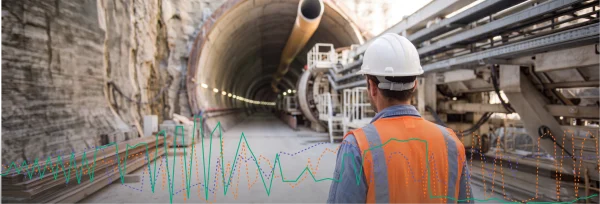
What happens when you’re building major infrastructure or buildings next to a hospital performing surgery, an IVF clinic storing embryos, or a research laboratory housing multi-million-dollar scientific equipment?
For many projects, managing vibration isn’t just about protecting buildings or reducing impacts on nearby residents. It’s about ensuring sensitive equipment continues to operate safely and accurately while construction takes place nearby.
This challenge is becoming increasingly common. Across Australia and New Zealand, major projects are being delivered closer than ever to hospitals, universities, laboratories, data centres and advanced manufacturing facilities.
With the addition of VC Curve monitoring SiteHive Vibration monitoring now measures all three core types of vibration impact: structural vibration (PPV), human comfort vibration (VDV) and sensitive equipment, as well as ground-borne noise (LAeq) monitoring.
What are VC Curves?
VC (Vibration Criteria) Curves are internationally recognised thresholds used to assess the impact of vibration on sensitive equipment and spaces.
Originally introduced in the 1980s, the criteria have evolved into the industry-standard approach for managing vibration-sensitive environments. Unlike traditional construction vibration measurements, which focus on peak impacts, VC Curves assess continuous vibration levels using RMS velocity measurements across a range of frequencies. The lower the VC Curve classification, the more sensitive the environment.
Examples where VC Curve measurements are useful include:
- Hospitals and operating theatres
- IVF clinics and medical facilities
- University research laboratories
- Scientific instruments and microscopes
- Semiconductor manufacturing
- Advanced manufacturing facilities
- Data centres
- Precision testing environments
In some cases, the vibration levels being assessed are thousands of times smaller than those typically monitored for structural damage.
The problem with traditional VC Curve monitoring
Historically, VC Curve monitoring has been difficult to implement at scale. Projects typically rely on specialist vibration equipment that captures raw measurement data. Consultants or specialists then manually process, analyse and interpret the results before producing reports.
While effective for short-term assessments, this approach can be expensive, time-consuming and difficult to apply continuously throughout a multi-year construction project. The result is a significant gap between collecting data and taking action.
Project teams often receive complex datasets but lack the tools to understand quickly whether vibration levels are acceptable, identify issues in real time or respond before impacts occur.
SiteHive set out to change that, providing the tools project teams need to manage vibration impacts on sensitive equipment within SiteHive Enviro Pro software.
Introducing VC Curve monitoring in SiteHive Enviro Pro
Rather than simply measuring vibration, SiteHive’s new VC Curve capability delivers an end-to-end workflow for construction-phase compliance monitoring within SiteHive Enviro Pro.
Project teams can now monitor vibration impacts on sensitive equipment in real time, receive notifications when thresholds are exceeded and investigate events through the same SiteHive platform they already use for noise, dust and vibration management.
Real-time RMS Velocity monitoring
Users can now view RMS velocity measurements directly within Enviro Pro, providing a clear picture of vibration conditions throughout the day.
Automatic comparison against VC Curves
Measurements are automatically presented against recognised VC Curve thresholds, making it easy to understand compliance at a glance. Instead of manually processing data and plotting results, users can immediately see where vibration levels sit relative to project requirements.
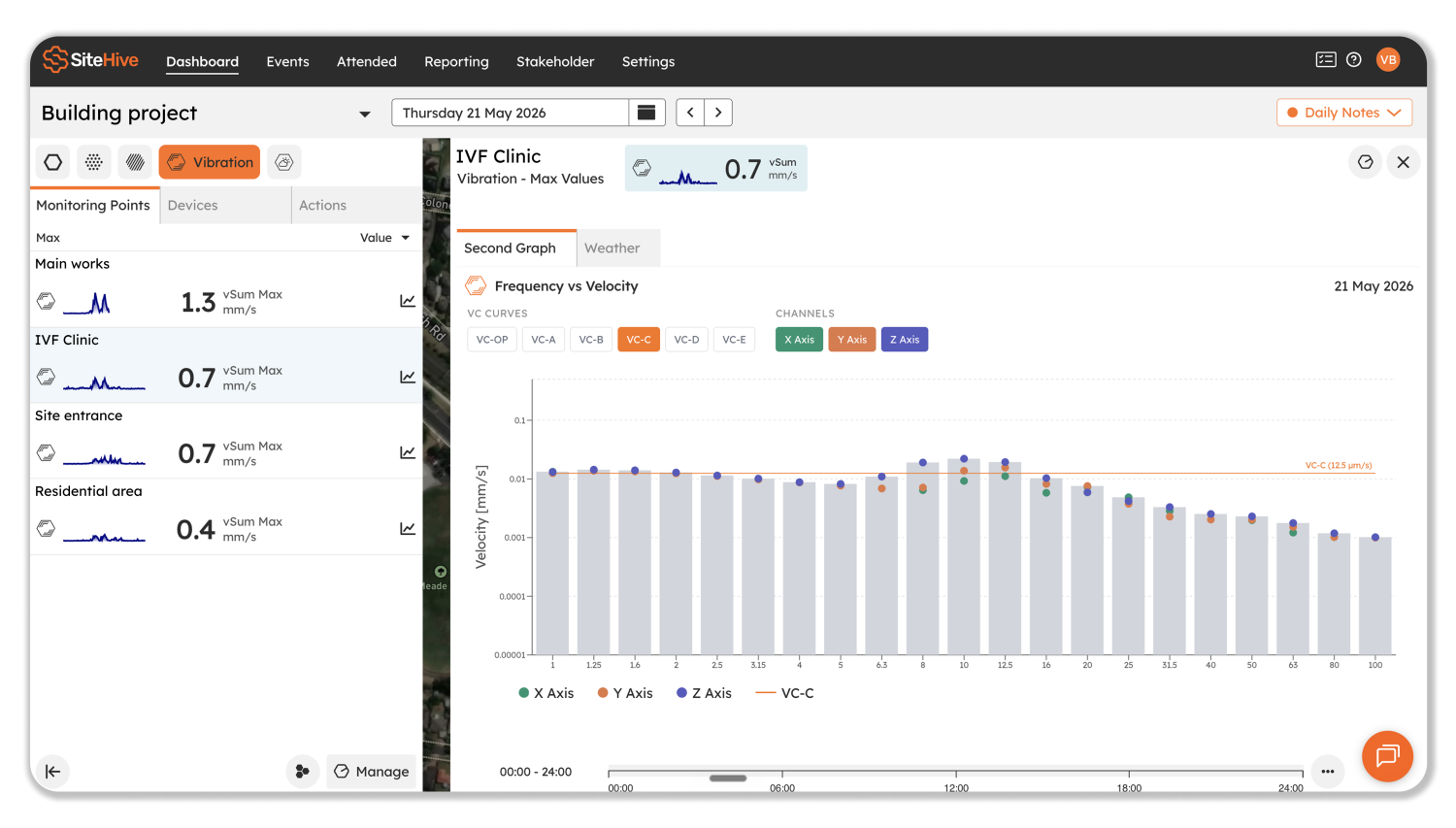
Timely notifications when exceedances occur
For sensitive environments, speed matters. Project teams can configure alerts against selected VC thresholds and receive notifications when vibration levels exceed acceptable limits, enabling rapid intervention on site.
Deeper investigation through waveform analysis
When exceedances occur, users can drill into SiteHive’s waveform tools to understand exactly what happened, when it happened and which frequencies contributed to the event. This provides the detail required for investigation while maintaining a simple day-to-day user experience.
Built for construction projects
One of the biggest challenges with VC Curve monitoring is that it has traditionally been designed for vibration specialists. SiteHive has taken a different approach. We’ve focused on making sensitive equipment monitoring accessible to project teams, environmental managers, contractors and consultants who need actionable information rather than highly technical datasets.
The result is a simpler workflow that helps people answer the questions that matter most:
- Are we compliant?
- When did exceedances occur?
- What caused them?
- What action should we take?
By surfacing the right information at the right time, teams can respond faster and reduce risks to sensitive facilities.
Who would benefit from VC Curve monitoring?
SiteHive’s VC Curve monitoring is designed for contractors, consultants and operators undertaking continuous compliance monitoring during construction or operation near sensitive environments.
It’s also an excellent tool for consultants running short-term attended assessments pre-construction.
Vibration Monitoring for Hospitals, Laboratories and Universities
The construction and operational industries are changing. As cities become denser and critical infrastructure increasingly sits alongside major projects and buildings, vibration management is becoming more complex.
Projects and operations are no longer being delivered beside empty spaces. They’re being delivered next to hospitals performing surgery, laboratories conducting research, manufacturers producing advanced technology and data centres operating around the clock. These environments require a new approach to environmental monitoring.
VC Curve monitoring extends SiteHive’s environmental intelligence platform into one of the most specialised areas of vibration management, helping customers confidently manage impacts on sensitive equipment while maintaining productivity.
For projects and operations near hospitals, universities, laboratories, data centres and other vibration-sensitive facilities, it’s an important new capability. It’s also another step towards making environmental monitoring simpler, smarter and more actionable.
Completing the real-time vibration monitoring picture
Construction vibration impact is typically assessed in three ways:
- Structural impact monitoring measures whether vibration could damage buildings or infrastructure.
- Human comfort monitoring measures whether vibration may be perceptible or disruptive to people.
- Sensitive equipment monitoring measures whether vibration could affect precision equipment, laboratories, medical facilities or manufacturing processes.
SiteHive Hexanode Vibration devices now support all three monitoring types in a single device: structural impact monitoring through Peak Particle Velocity (PPV), human comfort monitoring through Vibration Dose Value (VDV) and sensitive equipment through VC Curves.
In addition, SiteHive Vibration also provides ground-borne noise monitoring through LAeq, providing a way to estimate the impacts of ground-borne vibration without intrusion.
With the introduction of VC Curve Monitoring, customers can now manage all four categories using a single SiteHive vibration device via the SiteHive Enviro Pro platform.
When is VC Curve monitoring available?
VC Curve monitoring is available as a SiteHive Enviro Pro feature now. To learn more about enabling VC Curve Monitoring on your project, contact the SiteHive team.
FAQ
What you’ll find out:
- What are VC Curve measurements and why they’re important
- All about the new VC Curve measurements in SiteHive Vibration
- Where VC Curve measurements are most useful on construction and operational sites
Like more info?
Discover how SiteHive Hexanode devices and SiteHive Enviro software make real-time environmental monitoring easy.