Advancing AI Acoustic Classification for Construction Noise Monitoring: A New Frontier in Environmental Monitoring
Construction noise management is one of the most complex environmental challenges facing infrastructure delivery in dense urban environments. Traditional approaches rely on manual analysis or simple decibel thresholds — methods that struggle to distinguish specific noise sources or adapt in real time.
In a recent major study, a research team led by SiteHive demonstrated how an AI-based acoustic classifier can dramatically improve construction noise monitoring and analysis, delivering accurate, real-time classification of noise and differentiating between construction-related and other general noise.
This research explores:
Can AI be used to identify and classify construction noise in real-time based on data captured by unattended monitoring devices, including differentiating it from non-construction noise?
Authors
Halkon, Benjamin (1), Darroch, Michael (2), Cooper-Woolley, Ben (2), Zhao, Sipei (1), Miller, Aaron (3), Hanson, David (3), Marrinan, Matthew (4), Hendy, Andrew (4) Parnell, Jeffrey (1,4) and Mifsud, Stephanie (5)
(1) Centre for Audio, Acoustics and Vibration, UTS, Ultimo, NSW 2076, Australia; (2) SiteHive, Surry Hills, NSW 2010, Australia; (3) Acoustic Studio, Stanmore, NSW 2048, Australia; (4) Sydney Metro, Sydney, NSW 2000, Australia; (5) Gamuda Laing O’Rourke Consortium, North Sydney, NSW 2060, Australia
Abstract
Recent advances in AI technology have lowered the barrier to entry and cost of ownership of Internet-of-Things (IoT) related sensing. This may present opportunities to supplement or replace the current approaches for construction noise management with dynamic, real-time systems which can provide direct feedback to site managers. Improvements in noise predictions and better real-time tools will also convey strong benefits to surrounding impacted communities.
This paper describes a pilot project that aimed to establish that AI is suited to airborne noise data analysis and predictive capability and can be improved with increasing training data in the context of construction noise. Existing technology developed by SiteHive, which can predict noise sources from audio recordings, was deployed on Sydney Metro construction sites with audio gathered from a number of typical activities. Using accepted measurements of AI model accuracy, it is demonstrated that the Audio Classifier (AC) was able to increase its predictive accuracy from 29% to 81%, within 14 shortlisted classes comprising 10 construction and four non-construction categories. A strong predictive capability and rapid learning with an increased body of training data demonstrate the potential of the AC in this and other applications in
environmental acoustics.
What the research paper explored
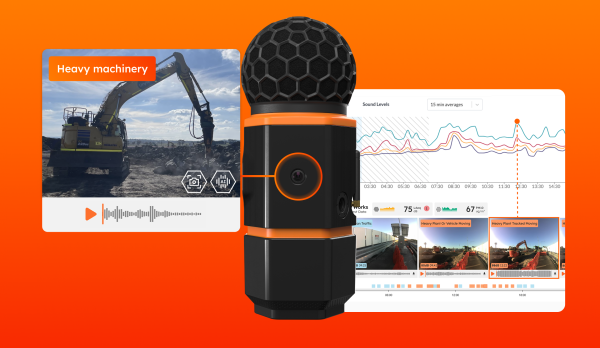
This study investigated whether machine learning can enhance how construction noise is detected and classified in the field. The study deployed SiteHive noise monitoring technology on Sydney Metro sites, using SiteHive Hexanode devices to collect audio from typical construction activities, as well as associated non-construction noise such as background ambient noise and traffic. It then used AI models to classify these sounds automatically.
The central goal was to move beyond simple noise level monitoring toward smart noise classification, enabling environmental teams to understand what is generating noise, not just how loud it is.
An AI breakthrough in sound classification
The SiteHive AI Audio Classifier used in the study improved its predictive accuracy to 81% when trained with labelled construction noise samples. This means that the system could correctly identify and categorise specific noise sources — such as excavation, machinery movement, or equipment operation — far more effectively than basic threshold-based methods.
How it worked
The pilot was conducted using:
- Unattended SiteHive Hexanode noise monitoring devices that capture continuous noise levels as well as audio files.
- Cloud-based machine learning models that utilise advanced audio tagging techniques.
- Iterative model training with labelled data gathered during live construction works.
This combination allowed the classifier to “learn” typical construction noise signatures and improve with each iteration, making the model more robust as the dataset grew.
Why this matters for environmental noise monitoring
Traditionally, construction noise monitoring has focused only on sound levels (e.g., LAeq readings) and has relied on manual expert interpretation, which is both costly and slow. AI-driven classifiers provide significant benefits including:
- Real-time noise source identification – teams are able to pinpoint which activity or equipment is creating exceedances, aiding proactive mitigation
- Better community impact management – identifying specific noise sources allows for proactive management and clearer reporting to residents and regulators
- Reduced manual analysis burden – AI classifiers automate what has been a time-intensive process that could often require specialist acoustic expertise
- Scalable deployment – AI runs on cloud platforms, making it practical for large, multi-site infrastructure projects.
AI-enhanced acoustic classification represents a leap forward. It aligns with modern environmental compliance needs, where simply measuring noise levels is often insufficient without contextual understanding of sources.
SiteHive’s role in modern noise monitoring
This research highlights how SiteHive’s innovative technology forms the foundation for intelligent acoustic analytics:
- Unattended SiteHive Hexanode Noise devices capture continuous real-time sound data
- Machine learning models, developed on construction sites in conjunction with real-world users, classify construction activities automatically
- The SiteHive Audio Classifier, an AI tool built into the SiteHive Enviro Pro cloud-based software platform, identifies and labels the noises
- Dashboards within SiteHive Enviro Pro provide clear visual insights to make construction exceedances easy to spot, while automated alerts notify teams immediately.
Results
The research shows that AI-based acoustic classification can be highly effective for construction noise management. With accuracy improving significantly as training data grows, this approach offers a powerful new tool for classifying and labelling monitored noise on construction projects.
Key results from the research include:
- The SiteHive Audio Classifier had a high degree of predictive performance for the target construction noise sources, with an F1 Score of 81%.
- It is likely the outcome can be further improved by increasing the number and variety of construction audio samples used to train the model. The predictive performance of the AC was improved by 52% with the addition of labelled audio files, demonstrating a strong capability for the AC to learn and improve predictive performance.
- The research demonstrates that construction site audio data is a suitable input into AI models and enables AI models to make useful predictions for the purpose of managing noise impacts.
Conclusion and potential for predictive noise modelling
For contractors, consultants, regulators, and environmental teams, AI-driven acoustic classification marks a new era in environmental monitoring — one where data is not only collected but truly understood.
The research also demonstrates that AI audio classifier technology has the potential to significantly improve predictive noise modelling on construction sites. Traditional modelling and monitoring approaches often rely on conservative assumptions, as they are designed to account for worst-case scenarios rather than real-world operating conditions.
By analysing audio streams in real time, AI classifiers enable noise modelling predictions to better reflect actual conditions on site as construction progresses. This allows project teams to maintain productivity while minimising impacts on nearby communities.
Over time, the granular data generated through real-time monitoring and AI classification across multiple projects will contribute to more comprehensive databases of real-world construction noise impacts. These datasets can improve prediction accuracy and reduce the costly consequences of overly conservative modelling — such as unnecessary relocation of residents or the installation of mitigation measures like noise barriers where they are not actually required. More accurate predictions can help streamline construction activities and reduce the overall duration of impacts.
In practice, these systems could provide live dashboards showing which activities are generating the most noise and whether they are approaching regulatory limits. Site managers could then adjust operations in real time by pausing high-impact equipment, staggering noisy tasks, or deploying temporary mitigation measures. As the dataset grows, predictive accuracy will continue to improve, enabling regulators and contractors to establish more realistic thresholds while maintaining strong community protections.
Read or download the full Research Paper
FAQs
References
- Braun, S. a. (2024, July 20). Multi-label audio classification with a noisy zero-shot teacher. Retrieved from arxiv.org: https://arxiv.org/pdf/2407.14712
- Cooper-Woolley, B. D. (2022). Initial design, development & calibration of mems based sound level meter for real-time construction monitoring. Proceedings of Acoustics 2022, The nature of acoustics. Wellington: The Acoustical Society of New Zealand.
- Gong, Y. C. (2021). Improving audio tagging with pretraining, sampling, labeling, and aggregation. IEEE/ACM Transactions on Audio, Speech, and Language Processing, (pp. 29: 3292–3306).
- Plumbley, M. a. (2022). Creating a new research community on detection and classification of acoustic scenes and events: Lessons from the first ten years of DCASE challenges and workshops. INTER-NOISE and NOISE-CON Congress and Conference Proceedings (p. https://api.semanticscholar.org/CorpusID:256854604). Glasgow: I-INCE.
- Salamon, J. J. (2014). A dataset and taxonomy for urban sound research. Proceedings of the 22nd ACM international conference on Multimedia, (pp. 1041-1044).
- SiteHive. (2024). SiteHive home page. Retrieved from https://sitehive.co
- SLR Consulting Australia Pty Ltd. (2023, May). Sydney Metro West – Western Tunnelling Package (WTP) Detailed Noise and Vibration Impact Statement (DNVIS) – Westmead to Sydney Olympic Park. SLR Ref No: 610.30644-R02-v5.0-20230530.docx.
- Stone, M. (1974). Cross-Validatory Choice and Assessment of Statistical Predictions. Journal of the Royal Statistical Society. Series B (Methodological), 36(2), 111-147.
- Virtanen, T. P. (2018). Computational analysis of sound scenes and events (Vols. ISBN: 978-3-319-63450-0). Springer Cham.
- Xiao, T. H.-W. (2023). Environmental noise tagging via audio spectrogram transformer. INTER-NOISE and NOISE-CON Congress and Conference Proceedings, InterNoise23 (pp. 7394-7400). Chiba, Japan: Institute of Noise Control Engineering.
What you’ll find out:
- How AI technology is used to classify sounds during construction
- Outcomes of testing AI classification on a major infrastructure project
- How AI classification can improve noise management
- Using AI for predictive noise modelling
Discover SiteHive Noise
See how you can use SiteHive devices and software to easily and accurately monitor and manage noise impacts during construction and operations. Including the AI Audio Classifier.