SiteHive Hexanode Vibration devices deliver new capabilities for managing the impact of vibration for infrastructure development, construction, tunnelling, transport, operational facilities and more.
Managing three core vibration types in one small device, they’re built to be smarter, more accurate, and deliver better insights.



What’s new in SiteHive Vibration monitoring?
NATA calibration for trusted compliance
SiteHive Hexanode Vibration devices now provide the peace of mind and traceability of NATA calibration.
SiteHive’s vibration monitoring devices can be NATA-calibrated by any independent NATA-accredited lab. You can organise this yourself, or SiteHive can provide the devices NATA-calibrated and ready to go, along with appropriate Certificates. Our calibration partners include Calibre and NVMS.
The device calibrations are traceable, documented and aligned with national and international standards. This includes:
- Calibrated against ISO 16063-21:2003
- Reporting and assessment aligned with DIN 4150-3 and BS 7385-2
NATA calibration is an optional feature, so if you don’t need this level of calibration, the devices come as standard fully calibrated by SiteHive. Either way, the new devices provide accurate, reliable data that meets the highest professional and technical standards, with the flexibility to have your devices independently NATA-calibrated whenever your project requires it. Read more on Australian & New Zealand standards for monitoring structural vibration.
Three vibration aspects in one compact device
SiteHive Hexanode Vibration provides real-time data on all three core vibration types. It measures structural vibration (PPV), human comfort vibration (VDV) and ground-borne noise. All data is visualised in easy-to-understand graphs, so you can see issues immediately and monitor trends.
Ground-borne noise monitoring made easy
SiteHive Hexanode Vibration revolutionises the management of ground-borne noise, making it simple, cost-effective and non-intrusive.
How does it work?
SiteHive Hexanode Vibration devices measure vibration data continuously in real-time; SiteHive Enviro Pro software then uses this to estimate ground-borne noise in decibels (LAeq). This provides a real-time picture of ground-borne noise without entering homes.
SiteHive’s ground-borne noise monitoring provides a range of benefits for contractors, consultants and stakeholders, including:
- Unintrusive – no in-home microphones required.
- Real-time and scalable – making it easy to monitor multiple locations at once.
- Easy to interpret – visual dashboards show ground-borne noise alongside PPV and VDV vibration metrics.
- Regulatory aligned – designed in line with State policies and international guidelines.
- Validated – the solution has been field-tested on major tunnelling projects with accuracy within 1dB.
Better insights: Automated frequency assessments
Using SiteHive Hexanode Vibration with SiteHive Enviro Pro software provides the added benefit of automated frequency assessments.
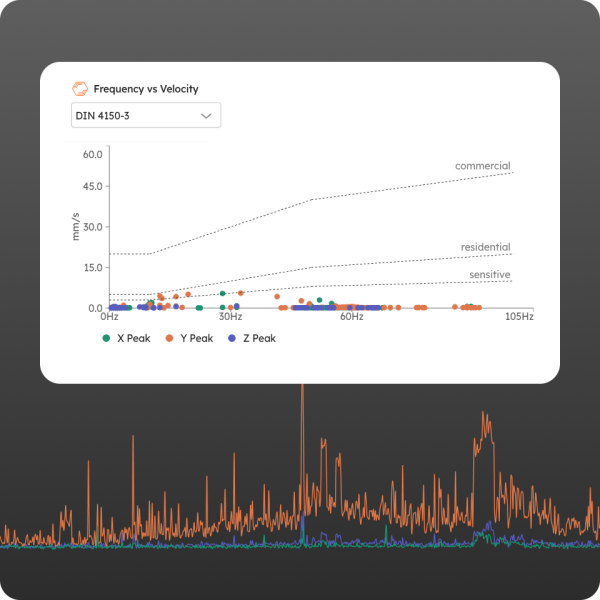
Frequency assessments are critical for managing structural vibration. Understanding the different frequency components of vibration helps to prevent resonance, identify vibration sources, pinpoint weak areas, monitor structural health, and establish appropriate vibration limits for safe operation and construction.
The software automatically undertakes structural damage frequency assessments based on DIN 4150-3 and BS 7385-2, and presents the data in graphical form. This saves time and effort, and makes it easy to identify any issues.
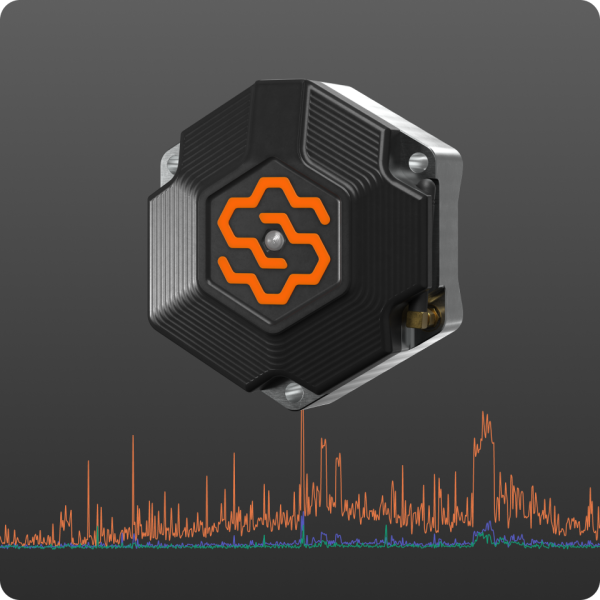
Self-orienting in any direction
SiteHive Hexanode Vibration is easy to deploy in any situation: hard ground, soft ground or wall-mounted. The device automatically self-orients in any direction, so you’re always getting an accurate picture of vibration impacts.
Stronger connectivity options
All SiteHive Hexanode devices now come with multi-network support, including 4G and Wi-Fi. Network roaming allows you to choose the best available network, to help ensure consistent, reliable data no matter where the devices are located.
Pair with SiteHive Hexanode Noise devices for images & audio
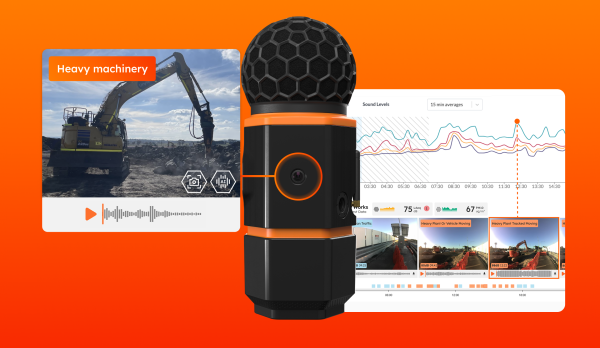
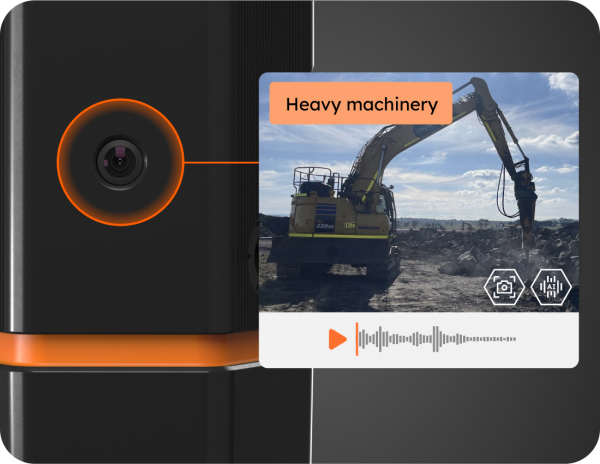
Co-locating SiteHive Hexanode Vibration with a SiteHive Hexanode Noise device gives you access to additional information, including images, audio files, and AI-powered audio classification & image labelling. This makes it even easier to identify the sources of vibration and noise events, and determine if they are site-created.
Easy to deploy, easy to maintain
The next-gen Vibration devices are designed for easy deployment and zero fuss. They are:
- Small and lightweight, making them easy to use anywhere and move around as required
- “Plug-and-play” setup – simply place in location and they immediately start delivering data
- Automatic cloud pairing to deliver data to SiteHive Enviro software
- A range of mounting options for hard or soft ground, and wall-mounting. They can be used on sensitive heritage structures too
- Support from our team of experts if you need it.
Not just devices: a complete environmental management system
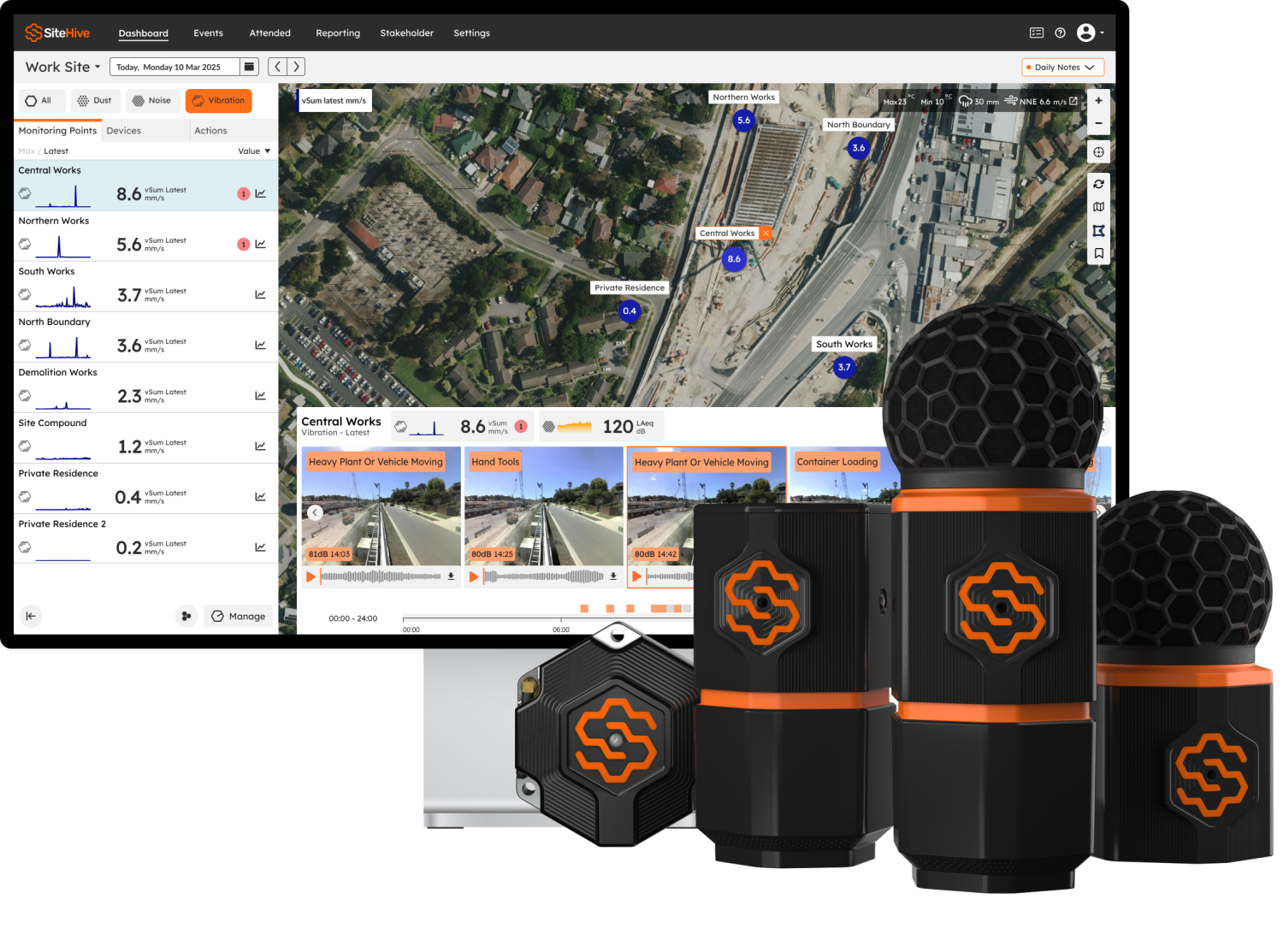
Every SiteHive Hexanode monitoring device syncs seamlessly with SiteHive Enviro, SiteHive’s award-winning, cloud-based software platform. From here you can view, analyse and report on everything.
Data and contextual information from noise, dust, vibration, water, weather, and more – it’s all in one place: at your fingertips. So you can see trends, pinpoint causes, and act faster than ever.
Built for the full project lifecycle
From pre-construction assessments and baseline monitoring, through peak construction activity, and on to post-completion reporting, handover and operation, SiteHive Hexanode Vibration monitoring is designed to support all phases of a project:
| Phase | Use case |
|---|---|
| Planning | Baseline monitoring |
| Construction | Real-time vibration levels for structural, human comfort and ground-borne noise; automated analyses and frequency assessments; alerts; vibration mapping |
| Community and stakeholder engagement | Transparent stakeholder reporting – PDFs and live online views |
| Compliance | Audit-ready data, analysis and reporting |
| Operational handover/closure | Final summaries and handover information & documentation |
Key use cases – where SiteHive Vibration monitoring is designed to help
- Urban infrastructure development
- Transport, including road and rail
- Tunnelling
- Demolition and excavation
- Civil works
- Building – schools, hospitals, health facilities, data centres, residential property
- Sensitive and heritage development
- Ports
- Data centres
- Airports
- Mining and quarrying
- Industrial site management
- Environmental consulting and auditing
Supported standards and compliance
SiteHive Hexanode Vibration supports assessments in line with key Australian and international standards, including:
- DIN 4150-3 / BS 7385-2 – Structural vibration and building damage
- DIN 4150-2 / BS 6472 – Human comfort vibration in buildings
- ISO 16063-21:2003 – Calibration of vibration transducers (NATA standard)
Using these standards ensures vibration data is accurate, defensible and suitable for regulatory submissions, impact assessments and formal compliance reports.
Technical overview
| Feature | Specification |
|---|---|
| Vibration monitoring | Real-time, continuous data |
| Measurements | PPV, VDV, ground-borne noise (DIN 4150-3, BS 7385-2); 1KHz sampling rate; ±4g measurement range; 0-250Hz frequency range; tested by NMI in line with ISO 16063 – 21:2003 |
| Media | 3-second detailed waveforms for events over thresholds; 1000 samples /second. Use alongside SiteHive Hexanode Noise for image capture and audio recording |
| Calibration | NATA or factory calibrated |
| Access | Cloud-based |
| Data sync | Automatic to SiteHive Enviro |
| Connectivity | 4G, network roaming, Wi-Fi |
| Dimensions | 57mm (H) x 140mm (L) x 130mm (W) 1.1kg, IP68 rated |
| Deployment | Self-orienting in any direction. Easily mountable, multiple in-ground options. Small and robust. |
| Power | 0.28W (10+ weeks on 35aH battery). Solar, battery or mains power. |
Summary
SiteHive Hexanode Vibration devices are designed specifically to meet the challenges and standards of construction and operation in Australia and New Zealand. Whether you’re managing a major urban development, tunnelling on transport projects, or working around heritage structures, these devices give you accurate data, efficient workflows and smarter tools. They enable confident decision-making and put you in control.
- Monitor more locations across your site, cost-effectively
- Have confidence in your data, with NATA calibration if required
- Monitor structural (PPV), human comfort (VDV) and ground-borne noise
- Get alerted to events
- Respond faster to exceedances
- Fulfill compliance obligations with easy reporting and analysis
- Engage stakeholders with live dashboards and easy-to-understand reports
Like more info?
Get in touch with us any time if you have any questions, or if you need anything.
Talk to our team to schedule a demo, request pricing, or learn more about how next-gen SiteHive Hexanode Vibration would work for you.
- 👉 Explore SiteHive Hexanode Vibration
- 👉 Read the full release update on SiteHive’s next generation devices
Links to relevant vibration policies and standards in Australia and New Zealand
- Australia
- The AS 2436 Guide to Noise and Vibration Control on Construction, Demolition, and Maintenance Sites.
- Guide to damage levels from ground-borne vibration Policy for Industry (EPA NSW)
- The BS 7385-2:1993: Evaluation and measurement for vibration in buildings
- The DIN 4150-3:2016-12 A German standard for evaluating vibrations’ impact on structures.
- New Zealand:
- Additional references
- Mayers, A. (2009). Vibration Acceptance Criteria. Australian Bulk Handling Review, Aspec Engineering Pty Ltd. Available at: /mnt/data/Article-Vibration-Acceptance-Criteria.pdf.
- Australian Business Licence and Information Service (ABLIS). (n.d.). AS 2436 Guide to Noise and Vibration Control on Construction, Demolition and Maintenance Sites – ACT. Retrieved from AS 2436 Guide to Noise and Vibration Control on Construction.
- Intertek Inform. (n.d.). DIN 4150-3:1999-02 – Structural Vibration – Part 3: Effects of Vibration on Structures. Retrieved from DIN 4150-3:1999-02.
- European Standard. (1993). BS 7385-2:1993 – Evaluation and Measurement for Vibration in Buildings. Guide to Damage Levels from Groundborne Vibration. Retrieved from BS 7385-2:1993.
What you’ll find out:
- An overview of new features in SiteHive Hexanode Vibration devices
- NATA calibration for trusted data
- How to manage structural (PPV), human comfort (VDV) and ground-borne noise in one device
- How to save time, improve accuracy and save costs
Like more info?
Check out the next-generation SiteHive Hexanode Vibration devices or contact us for more details or questions.