In our first article, From Megaprojects to Megabuildings, we looked at how construction is becoming a buildings industry again. One of the biggest consequences of that shift is that more work is happening in dense urban environments.
Australia and New Zealand’s construction is happening in our suburbs, cities and towns. Which means working close to homes, schools, hospitals and businesses – places where every noise, dust and vibration impact is felt, noticed and reported. In this article we look at the challenges of building in dense urban environments, and how teams can manage them effectively.
Why is more construction happening in dense urban areas?
The short answer is policy and population. Governments want new homes built where jobs, transport and services already exist. Urban renewal and a new wave of hospitals, schools and data centres need to be close to communities. All this is pushing construction to where people are.
Housing targets are driving infill development
Under the National Housing Accord, all levels of government have agreed to build 1.2 million new well-located homes over five years from mid-2024. The National Housing Supply and Affordability Council reports around 244,000 dwellings were under construction in the March quarter of 2026.
A large share of that housing is planned for established areas:
- In NSW, around 82% of Greater Sydney’s housing targets are expected to come from infill development, rather than greenfield land.
- In Victoria, the government’s target is for 70% of new homes to be built in established areas. Between 2017 and 2022, only 53% of net housing additions in Melbourne were delivered there, so the pressure to build in existing suburbs is set to grow.
Megabuildings are landing in the middle of communities
Housing is only part of the picture. Hospitals, schools and other social infrastructure are, by design, built inside the communities they serve. Many hospital redevelopments happen on live campuses, next to wards and operating theatres that can’t close.
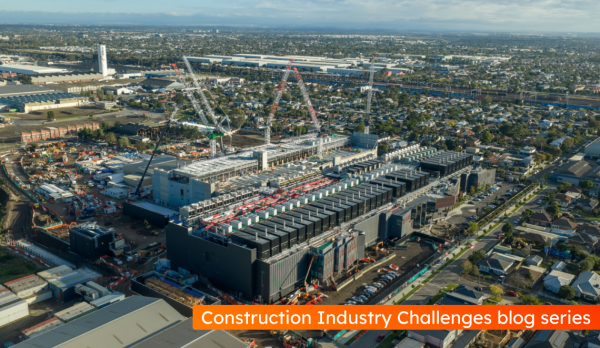
Data centres are also being built closer to homes on the edges of growing suburbs. They bring infrastructure-scale programs to single sites, often with intense community scrutiny.
These trends mean that more projects are being delivered in places where there’s little or no buffer between the works and the people living and working around them.
What are the challenges of construction in dense urban environments?
Building in a dense urban environment brings the same environmental impacts as any other project: noise, dust, vibration, water quality, disruption and pollution. The difference is how close and visible they become.
Sites are smaller, neighbours are closer and the scrutiny is higher. Managing environmental impact becomes more complex amidst lots of sensitive receivers: the potential impacts are greater, and there’s less time to respond to or mitigate issues.
The key challenges that need to be addressed include:
1. Sensitive receivers are metres away, not kilometres – and there are more of them
On an urban site, the nearest home, school or aged care facility can be across the lane or sharing a boundary wall. There is less distance for noise and vibration to reduce, less time to mitigate dust, and so limits are reached faster.
Importantly, too, density means more sensitive receivers of different types. Each nearby receiver can have different criteria. For example, a single site might need to manage residential noise limits, human comfort vibration for an office, structural vibration for a heritage terrace, and sensitive equipment limits for a medical facility, all at the same time.
Urban projects also do more out-of-hours work. Road occupancy rules, traffic management and rail possessions often push activity into nights and weekends, when noise limits are tighter and residents are more sensitive.
2. Noise is harder to separate from the city
Cities are noisy. Traffic, trains, sirens, and other construction sites all add to background levels. When an exceedance happens, teams need to know quickly whether it came from their works or from something else nearby.
SiteHive research across all deployed devices shows that 67% of noise exceedances are actually caused by external factors, not site works. So it’s important to be able to identify sources and causes quickly.
3. Dust travels and gets noticed
In dense areas, dust lands on cars, balconies, washing, cafe tables and open windows. Tall buildings can also channel wind through streets, moving dust in directions that are hard to predict.
With multiple sites and sources in the same area, it can be difficult to prove where dust actually came from. Without evidence, a project can easily be blamed for someone else’s impact.
4. Vibration affects structures, people and equipment
Excavation, piling, rock breaking and heavy vehicle movements in tight spaces can transmit vibration into neighbouring buildings. Older houses, heritage structures and shared walls can be particularly vulnerable.
Vibration affects people: they feel it, and it can be uncomfortable and disruptive. Ground-borne noise from basement excavation or tunnelling can be heard in offices or in bedrooms at night.
It can also affect precision equipment too. Near hospitals, labs and universities, even very small vibration levels can disrupt sensitive equipment. (We’ll cover this in more detail in our upcoming article, Protecting Sensitive Equipment in Dense Urban Construction.)
5. Tight sites limit where and how you can monitor
Urban sites have very little extra building space, and often have restricted access. Monitoring equipment has to fit on hoardings, rooftops, balconies and neighbouring properties, often without mains power.
As work moves from demolition to excavation to structure, the location of the highest risk moves too. Monitoring needs to be easy to relocate so it keeps happening where the impact is.
6. Cumulative impacts from multiple projects
In dense areas, several projects can run side by side, so communities experience the combined impact. This makes complaints harder to resolve, and puts more pressure on each contractor to show exactly what they are, and aren’t, responsible for.
7. Weather is amplified between buildings
In sites that are already dense and constrained, weather can have a significant impact on several fronts. Wind funnelling between towers affects crane operations and dust movement; heavy rain can quickly overwhelm urban stormwater systems; and heat build-ups can mean greater heat stress risk for workers.
Regional weather stations kilometres away rarely reflect what’s actually happening on an urban site.
8. Scrutiny, complaints and social licence
Urban communities are close, connected and quick to raise concerns with councils, regulators, local media and social media. Even a handful of complaints can lead to restricted work hours, extra conditions or stop-work orders, all of which can impact site productivity, increase costs and create additional issues.
Plus contractors and projects actively want to be good neighbours, minimising the impacts so that communities and businesses can continue to thrive while building progresses. And on urban projects, being a good neighbour isn’t only about impact and reputation – it directly affects productivity.
What does this mean for managing environmental impact in urban environments?
On a greenfield site, meeting minimum monitoring requirements may be enough. In a dense urban environment, that approach leaves too many gaps. Teams need to know what’s happening across the whole site, in real time, and be able to act before an impact becomes a complaint.
Achieving good outcomes on dense urban sites requires more proactive impact management. Some best practice activities for projects include:
- Monitoring more locations, closer to receivers, closer to the works. More monitoring points give a clearer picture of where impacts occur and how they travel. Monitoring close to the work that’s happening, rather than on boundaries, also provides more time for mitigation. See SiteHive’s guide to how many monitoring devices to use for a rundown on the benefits of more monitoring points and where to locate them.
- Acting in real time. Setting appropriate thresholds and using real-time alerts directed to the right people as limits are approached allows teams to change methods, move equipment or pause an activity before it becomes an impact.
- Having evidence, not just data. When there is an exceedance, contextual information like images, audio and automated classifications help teams show what caused it, and separate site impacts from external sources.
- Using data to plan the program. Understanding when and where impacts occur helps teams schedule noisy or vibration-intensive work at the best times, and keep work moving for more of the day.
- Communicating openly with the community. Clear, accurate data makes it easier to respond to complaints quickly and build trust with neighbours, communities, councils and regulators. The ability to share live data provides more information and better transparency for all these groups too,
This is the shift from compliance to confidence: using monitoring as a productivity and community-relations tool, not just a reporting requirement.
How SiteHive helps teams build in dense urban environments
SiteHive has supported construction across the busiest urban settings, from metro rail and tunnelling projects to hospital redevelopments and data centres. The SiteHive platform combines SiteHive Hexanode monitoring devices with SiteHive Enviro and SiteHive Enviro Pro software to monitor and manage noise, dust, vibration, water and weather in real time.
| Urban Challenge | How SiteHive Helps |
|---|---|
| Receivers metres away | Real-time noise, dust and vibration monitoring with rules and notifications that alert teams as limits are approached |
| Separating site noise from city noise | * Directional images & audio captured at the loudest moment * Direction-of-arrival mapping * Automated audio classification |
| Proving the source of dust | Images captured at the highest PM2.5/PM10 reading, alongside on-site wind speed and direction of arrival maps |
| Structures, people and sensitive equipment | Structural (PPV), human comfort (VDV), sensitive equipment (VC Curves) and ground-borne noise (LAeq) monitoring from a single vibration device |
| Tight, changing sites | Compact, mobile SiteHive Hexanode devices that are quick to deploy and relocate as work fronts move |
| Weather between buildings | Hyperlocal SiteHive Weather with alerts for wind, rainfall and wet bulb temperature, and forecast rainfall notifications |
| Complaints and scrutiny | Complete historical records, contextual media and PDF & CSV reporting to support fast, evidence-based complaint responses. Stakeholder views to share curated live data |
Small, mobile devices built for tight sites
SiteHive Hexanode devices are designed to be compact and easy to deploy. Which makes them easier to use across a site and in places like hoardings, rooftops and neighbouring properties. They can also be moved easily as the work moves, with multiple ways to power and a low power draw.
Evidence that shows what really happened
In a busy city, knowing that an exceedance happened isn’t enough. SiteHive Contextual Media captures images and audio at the most impactful moment of each monitoring period, so teams can see and hear what caused it: a truck, a jackhammer, a passing train, or works on the site next door.
This is backed by a range of other information-providing tools including:
- Direction-of-arrival mapping;
- The SiteHive Audio Classifier, which uses AI to provide immediate and automated identification and labelling of audio files;
- The SiteHive Waveform Classifier, which also uses AI to classify vibration events and reduce manual waveform analysis; and
- Integration with Timescapes site imagery adds even more context in the same platform.
These tools let you identify issues quickly and separate out the ones that are yours immediately – saving a huge amount of time, cost and effort on busy construction sites.
Complete vibration monitoring from one device
Dense urban sites often need to protect buildings, people and equipment at the same time. SiteHive Vibration monitors structural vibration (PPV), human comfort vibration (VDV), ground-borne noise (LAeq) and, through VC Curve monitoring in Enviro Pro, impacts on sensitive equipment. All four can be managed from a single monitoring point, with a single SiteHive Hexanode Vibration device.
Hyperlocal weather for urban conditions
SiteHive Weather measures rainfall, wind speed and direction, temperature, humidity and wet bulb temperature directly on site. Teams can set alerts for crane-limiting wind, rainfall and heat stress, receive forecast rainfall notifications, and see how wind is moving dust across and beyond the site.
Faster, clearer community responses
All monitoring data, images and audio sit together in one cloud-based platform, with full historical records and PDF and CSV reporting. When a complaint comes in, teams can quickly check what happened at that time and location, and respond with evidence.
The Stakeholder View also lets teams share a curated view of live data with anyone the project chooses – concerned residents, communities, councils, regulators, clients, etc. The view can be available directly to specific people, or placed on publicly available websites as required.
Over time, this transparency helps build trust with neighbours, councils and regulators.
Find out more
To learn more about how SiteHive helps teams manage environmental impact on dense urban construction projects, contact us or explore sitehive.com.
The Construction Industry Challenges blog series
This article, Construction in Dense Urban Environments: The Challenges and How to Manage Them, is part of our series examining the new challenges of environmental management in construction.
We’re covering the changing landscape of the construction industry, what it means for environmental management, how impact needs to be managed on today’s projects, and what SiteHive is building to help environmental teams, consultants, contractors and others respond.
Articles in the series include:
- From Megaprojects to Megabuildings: The New Shape of Construction
- Managing Weather Impacts on Construction Sites: Costs, Causes and Fixes
- Construction in Dense Urban Environments: The Challenges and How to Manage Them
- Protecting Sensitive Equipment in Dense Urban Construction
- Data centre builds – how to build faster and be a good neighbour
FAQs
References
- Treasury, Delivering the National Housing Accord – 1.2 million well-located homes over five years from mid-2024
- National Housing Supply and Affordability Council, Quarterly Report – August 2026 – 244,000 dwellings under construction in the March quarter 2026
- Urbis, Getting to 1.2 million: NSW sets agenda to meet its target – 82% of Greater Sydney targets from infill
- Victorian Department of Transport and Planning, Trends in population growth and housing supply – 70% established-areas target; 53% achieved 2017-2022
What you’ll find out:
- Why more construction is happening in dense urban areas
- The key challenges of building close to communities
- What this means for managing environmental impact
- How SiteHive tools help teams build faster and be a good neighbour
Discover SiteHive
See how you can use SiteHive devices and software to easily and accurately monitor and manage environmental impacts during construction and operations.